

Translation industry
The Cursed Book of Al-Baruh: Crisis in the Translation Industry
✦
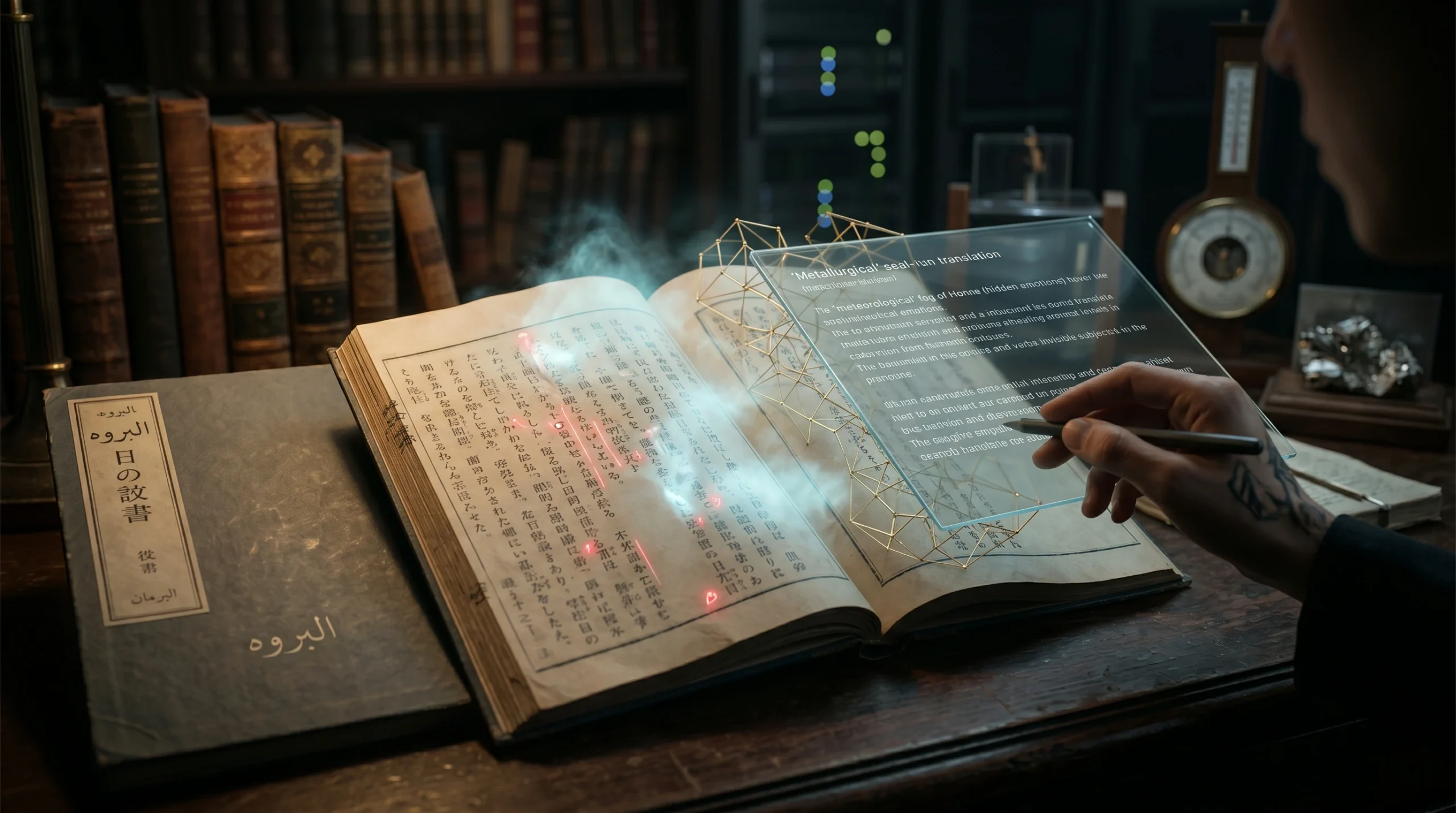
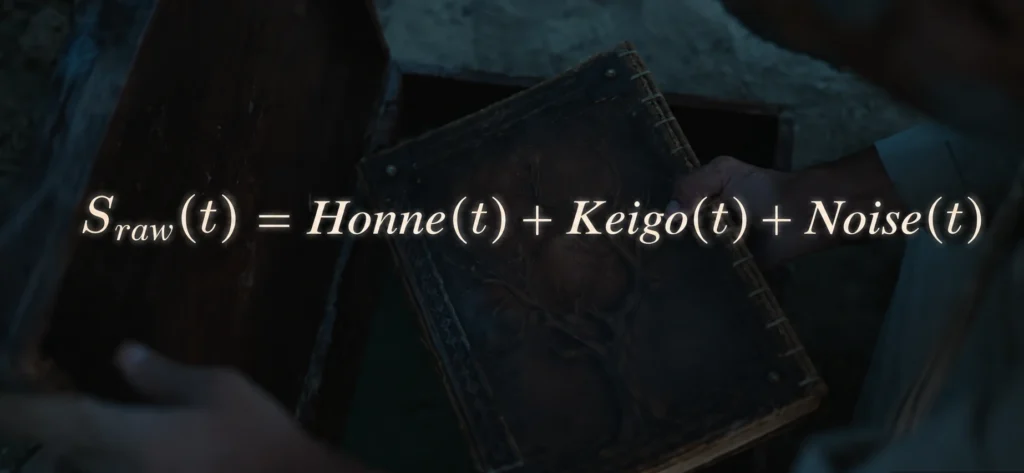
"Opening Japanese classics without the right tools is like opening the cursed book of Al-Baruh. In signal processing science, raw text (Sraw) is a complex signal in which emotions (Honne(and respect)Keigo) are combined with linguistic noises. "Ordinary translators cannot separate these variables, so the story takes over and the original tone escapes."
"Opening classic Japanese texts without the right tools is like opening a cursed book of Alborah; The main tone escapes and the story takes over."
The global publishing industry and digital streaming platforms have been fighting an invisible monster for years: the loss of the soul of Japanese stories in the translation process. Today's artificial intelligences read text linearly; As a result, hidden emotions (Honne) and the highly complex structure of respect (Keigo) in the Japanese language are lost. This cultural flattening has caused the creation of soulless translations and sheltering the audience in piracy. But what if we treated the text, not as a writing, but as an "invaded space"?
Step 1: Fog meter radar and uncover hidden emotions
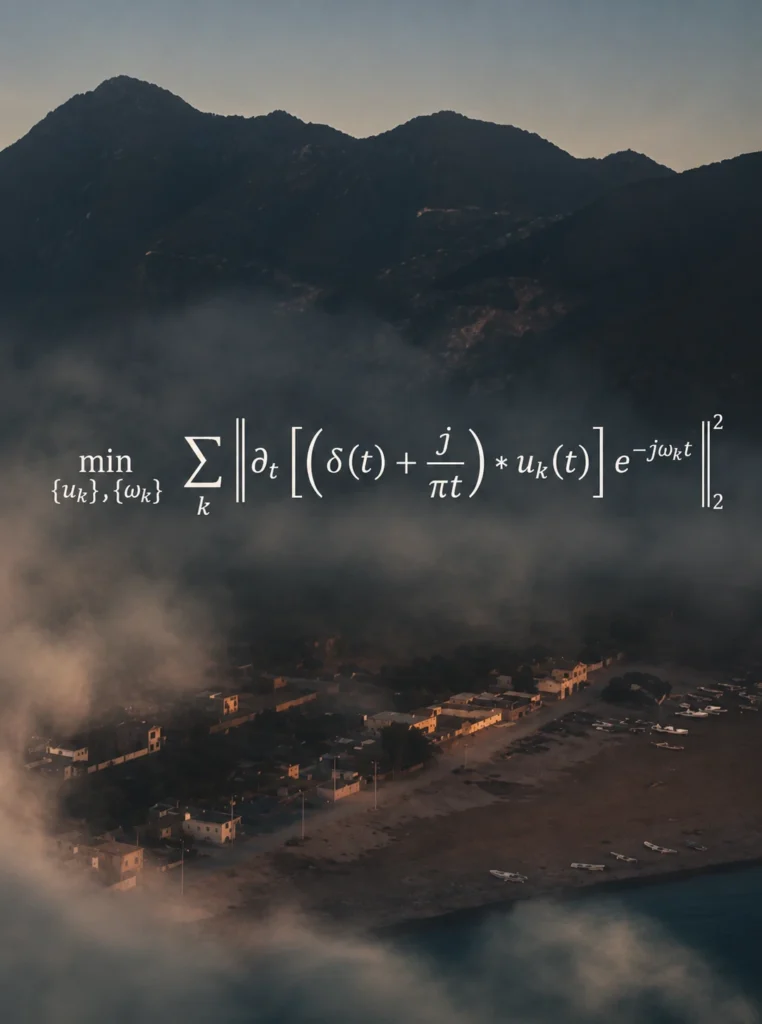
"The misty village in the series of Kaanat; A metaphor of intense ambiguity and emotional fogging (Honne) in Japanese texts, which is decoded by VMD algorithm, in fact, the meteorological fog meter system of the Qannad engine tracks the hidden emotions (Honne) like a weather change in the atmosphere of words.
In our innovative system, named after the legendary hunter, "Gannad Engine", we used weather algorithms (VMD) and type-2 fuzzy logic. Instead of translating the words, the system first filters their noise and predicts the "hidden atmosphere" of the story; Just like tracking the fog concentration before an attack by an unknown entity.
Second step: Afra criminal tracker for absent perpetrators
The Japanese language is a master of hiding subjects. We used crime detection methods in law (CRF/HMM algorithms) to find these ghosts in the text, rather than grammar. The system scans the crime scene of sentences and identifies the invisible subject.
A
What were the hypothetical input data?
We generated a file containing 100 raw Japanese sentences (numerically). These data included three hidden features:
- ۱
"Raw signal" (dispersion of emotions in text that is full of noise) - ۲
"Probability of the subject not being present" (how likely is it that the main character is invisible in this sentence) - ۳
"Level of Respect or Keigo" (a number between 1 and 5 that indicates the level of formality of the dialogue)
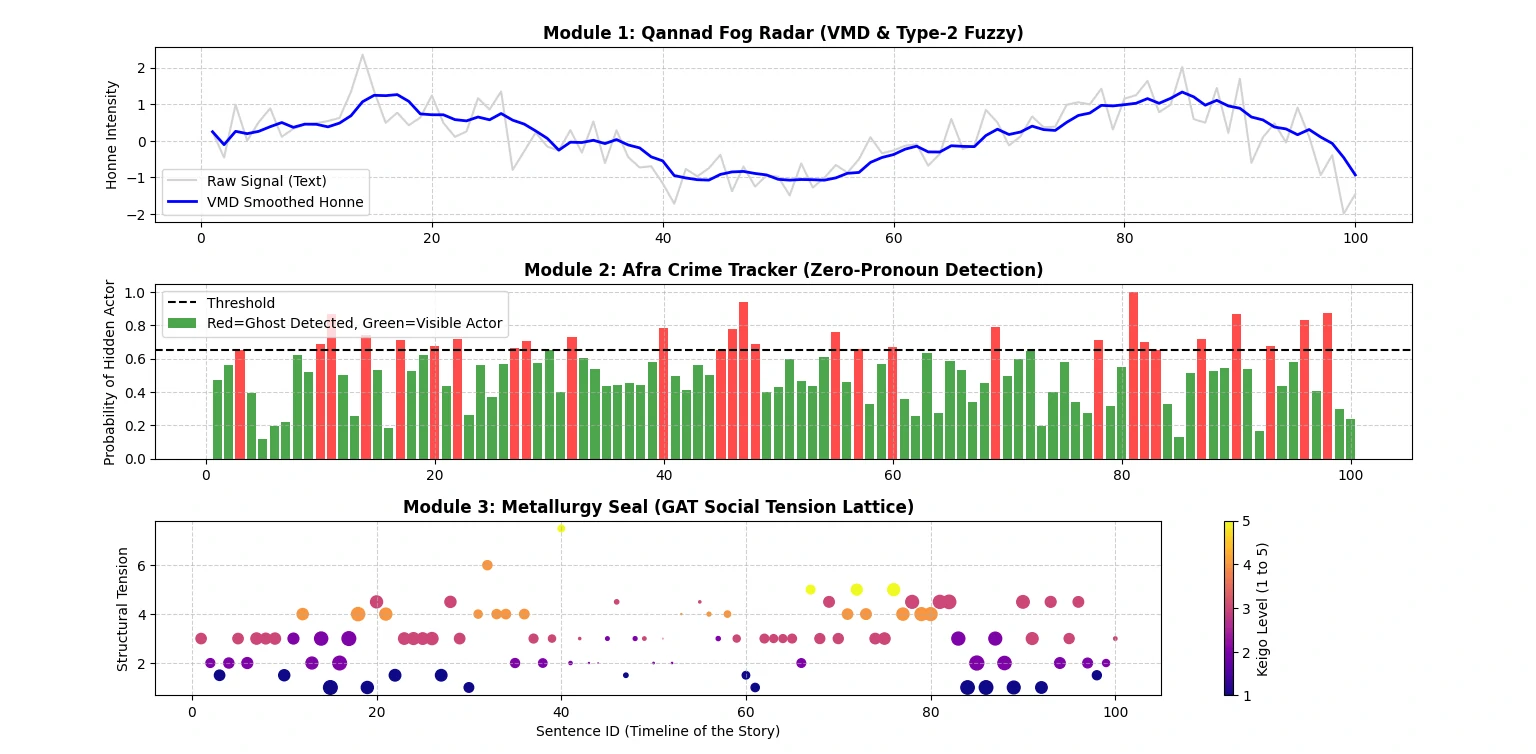
Analysis:
The first diagram (Gannad fog gauge radar):
what do we see A jittery gray line (raw text with misleading noise) and a smooth blue line (extracted signal).
The gray line shows that if a normal AI were to read the text, it would get confused by the apparent word fluctuations. But the blue line shows the performance of our VMD algorithm, which removed the noises and discovered the "main wave of emotion and Honne" like a weather radar.
The second diagram (Afra's criminal tracker):
what do we see A series of green and red bars, with a horizontal black dashed line (police sensitivity threshold).
The green columns are sentences in which the subject is clear (like an ordinary citizen). But the red columns are the sentences that have exceeded the dashed line of the threshold; This means that our CRF/HMM algorithms are able to find and capture "invisible genies" (deleted subjects in Japanese text).
The third diagram (metallurgical spell):
what do we see A scatter plot where the color of the dots (from dark blue to light yellow) indicates the level of respect (Keigo) and the size of the dots indicates the concentration of emotional fog.
This diagram shows how our engine maintains the metal structure of the language. The points that are higher on the vertical axis (tension) are the sentences whose subject is invisible and their level of respect is extremely high. These sentences are where machine translators like Google Translate break down and make mistakes. Our system detects these tensions to use stronger words (such as indefinite or respectful sentences) when generating English words.
The final step: a metallurgical talisman to maintain respect
"Graphic Neural Networks (GATs) Seal the Structure of Respect Like a Metal Crystal in the English Language."
To avoid collapsing the tone and level of respect (Keigo) when translating into English, we enlisted the help of material engineering science. The Qanad engine builds a network of crystal relationships (GAT) between characters. This "metallurgical spell" ensures that the final translation is produced with solidity and faithful tone, without breaking the social structure.
◆ ◆ ◆
The Qanad engine is not just a software; It is the next generation weapon to overcome the bottlenecks of translation and perfect commercialization of literature globally.
🛡️ Copyright rules and republishing content:
All intellectual and material rights, ideas and articles published on Qamar's website are reserved.
In order to protect the author's rights, all the textual and visual contents of the Qamar website are documented and archived by the international authorities of digital registration with the inclusion of the exact date and time (Timestamp) as the intellectual property of this collection at the moment of publication.
Republishing and using the contents of this site is allowed only by mentioning the exact name of the source and inserting a direct link (follow) to the main page of the article. In case of any unauthorized copying and without reference to the source, the recorded time priority documents will be sent directly to the search engines (in the form of Google DMCA forms) and the hosting company of the offending site, which can lead to the removal of links to the wrong site from the search results and the blocking of their server.