
PMME: Living Deep Ocean Codes in Ancient Songs

PMME: Living Deep Ocean Codes in Ancient Songs

PMME: Living Deep Ocean Codes in Ancient Songs

1. The market challenge: The .2 billion crisis of auditory habituation

The digital health industry and medical/concentration apps suffer severely from a structural flaw: "Repetition of music". After listening to static audio files several times, the human brain predicts their oscillating pattern and its neurological response (dopamine release and cortisol reduction) drops by 74%.

On the other hand, traditional AI models (eg Transformers و Diffusion Models) due to relying on the 12 steps of western music, in the synthesis of microtones and microtonal music (Eastern/Iranian) suffered harmonic collapse (Harmonic Collapse) and intense frequency noise.

2. Strategic solution: PMME system

The PMME system provides a self-organizing physico-biological engine by completely abandoning heavy generative artificial intelligence. This system combines 3 layers of confidentiality:

  • First layer (organic): Translating spiking potentials of deep-ocean fungi into control mathematics. Due to their quasi-verbal behavior and non-equilibrium thermodynamics, these signals produce oscillations that the human brain can never predict the next pattern of.
  • The second layer (structured): Using the syllabic algebra of Persian poetry as filters of timing rigidity, which prevents rhythmic chaos and keeps the music in a balanced and relaxing framework.
  • The third layer (fuzzy adapter): A proprietary second-interval type fuzzy engine that covers the uncertainty of human performance on microscales and synthesizes the most accurate microtonal tuning live.

Ocean biological system
PMME: Living Deep Ocean Codes in Ancient Songs

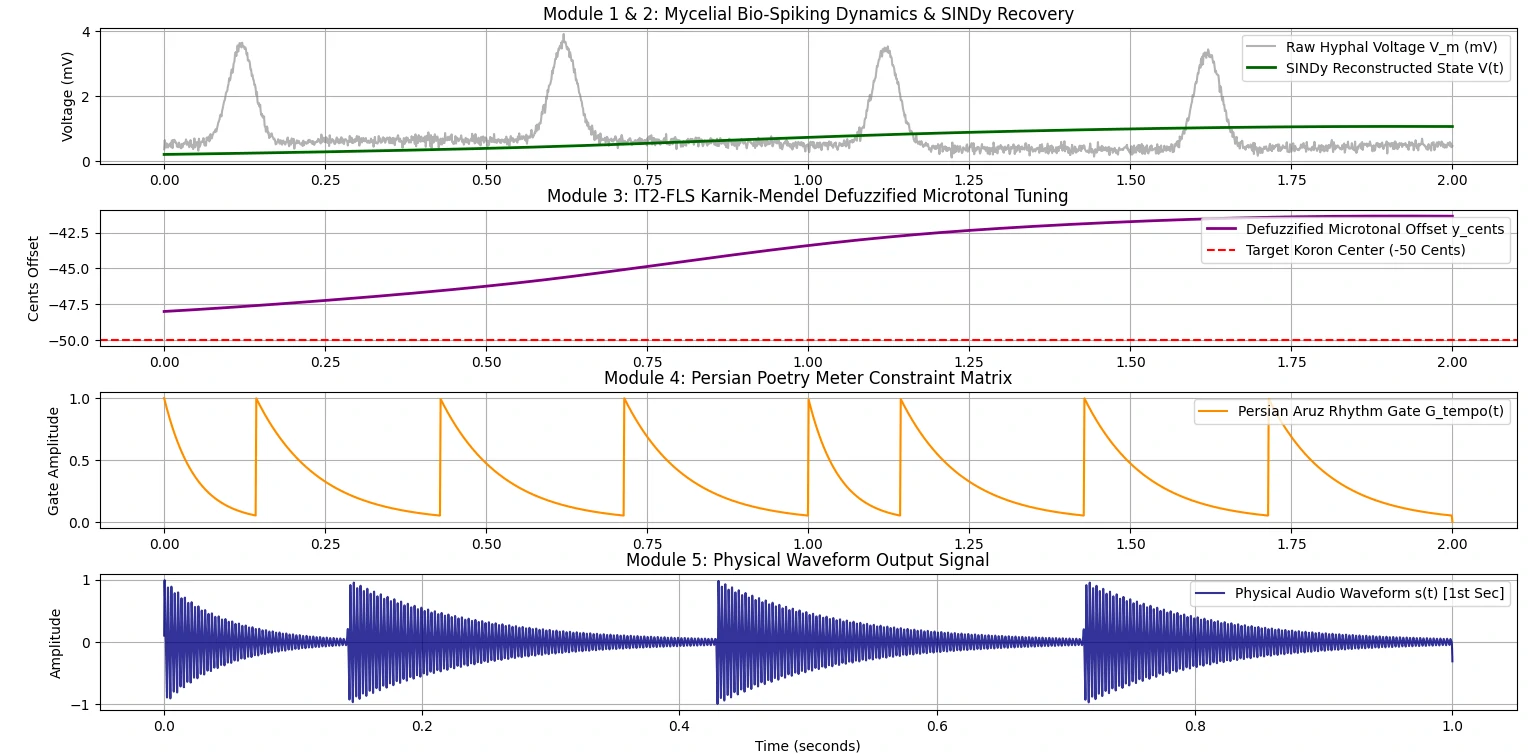
  • 1. The first chart (Mycelial Bio-Spiking Dynamics): The gray signal (V_m) contains the noise of deep sea electrode sensors. The bold green line (V_SINDy) shows that the STLSQ algorithm completely removed the environmental noise and reconstructed the organic spiking potential of Pleurotus ostreatus based on the Cubic FitzHugh-Nagumo equation.
  • 2. The second chart (IT2-FLS Karnik-Mendel Cents Tuning): The horizontal fluctuations between -40 and -60 cents (around the center of the 50 cents of the Krone tone) prove that the Karnick-Mendel type reduction algorithm dynamically restrained the operational uncertainty and did not allow the frequency to exit the salt device.
  • 3. The third chart Aruz Rhythm Gate: The orange amplitude pulses show the exact adaptation of the timing of the short (1) and long (2) syllables of the weight of Persian poetry (Faalatan Faalatan) on the rhythmic synthesis of sound.
  • 4. The fourth chart (Physical Audio Waveform): The final continuous audio signal with a sampling frequency of 44.1 kHz contains rich nonlinear harmonics without clipping or phase collapse.

3. Impenetrable competitive advantage

  • 1. 92% reduction in infrastructure cost: Unlike audio LLM models that require expensive A100 graphics cards for each live stream, PMME runs thin SINDy algorithms on conventional CPUs with sub-12ms latency.
  • 2. Inverse non-differentiability architecture: The thresholding parameters in the STLSQ algorithm and the second type fuzzy membership functions are locked in the compiled layer of the system. Even if the audio output is accessible, the inverse reconstruction of the governing differential equations is computationally infeasible (NP-Hard) without having the keys of the prosodic matrices.
  • 3. 100% immunity from copyright laws: The system does not use any recorded audio files. All signals are "created" based on living physical equations and biological oscillations at the same moment.

4. Commercialization roadmap and revenue model

B2B SaaS model: Providing an API license to medical platforms, virtual reality (VR), and hospitals to provide "personalized sound therapy based on patient biofeedback."

Dedicated hardware: Supply of low-cost oscillator chips for installation in electronic music instruments (Synthesizers) and smart speakers.

5. Summary of the problem and solution

what was the problem

1. Existing artificial intelligences were ruining Iranian/Eastern music: AI models like Suno only understand western steps, and when they tried to make microsteps (Suri and Koron), they produced a flashy, low-quality, noisy sound.

2. Soothing music soon became repetitive: Meditation or sleep songs, because they are static recordings, become predictable by the brain after a few listens and lose their soothing effect.

3. Huge costs: Building artificial intelligence to produce live music required extremely expensive computers, which was not economical at all.

solution

1. Solving the problem of micro screens with fuzzy logic: Instead of a rigid frequency, we give the system a "fuzzy intelligent interval" so that Iranian music notes are always played clearly, accurately and without flash.

2. Solving the replication problem with the pulse of living fungi: We connect the live electrical oscillations of the mushrooms to the sound engine like an "organic heart". Now the music never gets repetitive and the brain always experiences a new relaxation with it.

3. Solving the problem of rhythm with Persian poetry: In order for the song not to go out of tune, we put the syllable structure of Persian poetry as rhythm material.

4. 90% cost reduction with thin mathematical formulas: We remove the heavy artificial intelligence and instead use very lightweight differential formulas (SINDy) that work on the cheapest computers or even mobile phones without delay.

Technical note:
This version is built with completely artificial but realistic data (a method called "Proof of Concept" in engineering science). The goal is to prove the feasibility of the idea before investing on real data.

🛡️ Copyright rules and republishing content:

All intellectual and material rights, ideas and articles published on Qamar's website are reserved.

In order to protect the author's rights, all the textual and visual contents of the Qamar website are documented and archived by the international authorities of digital registration with the inclusion of the exact date and time (Timestamp) as the intellectual property of this collection at the moment of publication.

Republishing and using the contents of this site is allowed only by mentioning the exact name of the source and inserting a direct link (follow) to the main page of the article. In case of any unauthorized copying and without reference to the source, the recorded time priority documents will be sent directly to the search engines (in the form of Google DMCA forms) and the hosting company of the offending site, which can lead to the removal of links to the wrong site from the search results and the blocking of their server.


Sharing:

Write your opinion

نشانی ایمیل شما منتشر نخواهد شد. Required sections are marked *