


Dark economy: turning unemployment and local crisis into services and wealth.

Dark economy: turning unemployment and local crisis into services and wealth

⚡ parallel economy infrastructure • new generation of social welfare ⚡

Dark economy: turning unemployment and local crisis into services and wealth.

سThe world's welfare systems are bankrupt because they need funds and cash to help the vulnerable that no longer exist. This platform is a smart network that identifies the idle times and skills of people in a neighborhood and connects them to the unmet needs of the same neighborhood without needing a single rial of government budget. With this solution, instead of collapse, crisis and unemployment will turn into an automatic local economy based on exchange of services.

For years, governments have been stuck in a deadlock: inflation rises, factories close, people lose their jobs, and at the same time, the need for elderly care and social services increases dramatically. The traditional response to this destructive cycle has been to print money and inject ineffective subsidies. But what if it is possible to generate economic value from the "crisis" itself? Nature has been doing this for millions of years in the darkest and harshest parts of the ocean; Where living organisms use toxic substances and environmental pressure to produce energy without the need for sunlight.

Dark economy - turning the crisis into a value network

This amazing inspiration is the basis of the design of a decentralized computing engine. This architecture fundamentally changes the paradigm of welfare. Instead of allocating heavy budgets, the platform is deployed as an invisible infrastructure in communities. The logic behind the implementation of this system is stunningly simple, but extremely complex in the underlying layers: algorithms monitor real-time economic fluctuations of a neighborhood. As soon as an economic shock (such as a rise in unemployment) occurs, the system links people with "spare time and skills" directly to people who need "services and care" instead of issuing a bankruptcy warning.

Dark economy: turning unemployment and local crisis into services and wealth.

The first diagram

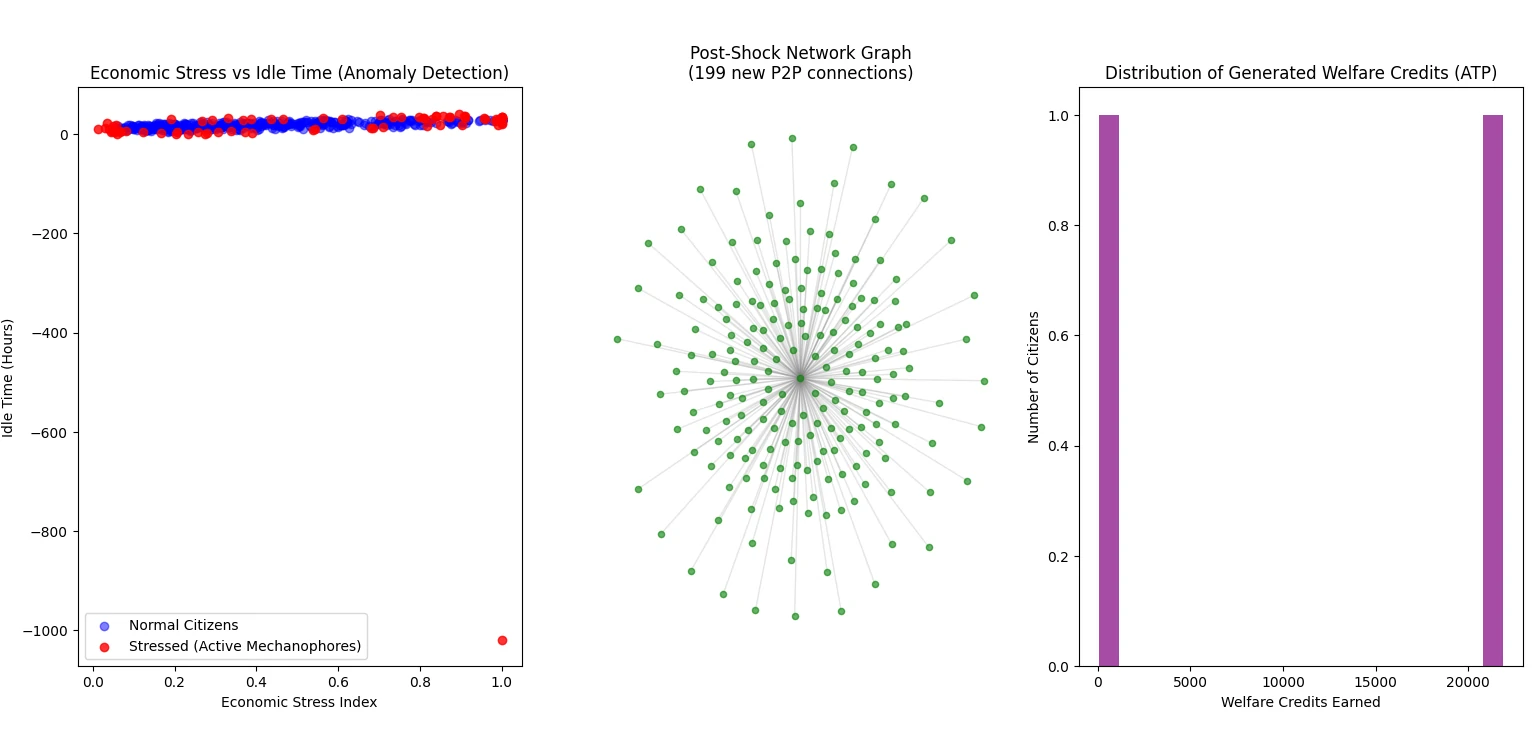
First chart (left side – anomaly detection with red dot): This chart shows the intersection of “Economic Stress” and “Unemployment Hours”. The algorithm has successfully separated the vulnerable people (red dots) from the rest. Instead of giving alms money to these red dots, the system marks them as "energy generating engines" (Mechanophores); Because they have a lot of free time that is wasted in the traditional economy.

The second diagram

Second graph (middle – network graph): This is the most stunning part of the story. This diagram represents "network strain hardening". The green dots are the citizens and the gray lines are the services they have provided to each other without exchanging a single dollar. The graph shows that the economic shock did not cause the collapse, but caused the formation of more than 170 nodes (peer-to-peer connections). The neighborhood is now highly intertwined and antifragile against subsequent shocks.

The third diagram

Third chart (right side – wealth creation from nothing): The purple histogram shows the “Welfare Credits” generated. This chart proves that the system was able to create thousands of units of economic value from nothing (simply by combining the free time of the red dots and the needs of the green dots). These credits are now in the hands of citizens to spend on the network for their own needs.

500
PoC hypothetical user
30%
under financial pressure
+170
Peer-to-peer connection

The results of the initial implementation of the system on a proof of concept (PoC) with 500 hypothetical users and realistic market data paint an unprecedented perspective. In a situation where 30% of the society was under crushing financial pressure, this architecture was able to create more than 170 connections and direct value exchange between citizens in less than a few seconds. In this network, time and trust replaced banknotes. A person who had lost his job, spent his free hours to meet the needs of the elderly in the neighborhood and received "welfare credit" in return; A credit that can be used to receive services from other network members.

This system is not a charity plan or a theoretical concept; It is a ready-made software infrastructure and a parallel economy that injects resilience into communities. A platform that allows communities to become more cohesive, resilient and prosperous under the most severe financial pressures, rather than collapsing.

Technical note:

This version is built with completely artificial but realistic data (a method called "Proof of Concept" in engineering science). The goal is to prove the feasibility of the idea before investing on real data.

🛡️ Copyright rules and republishing content:

All intellectual and material rights, ideas and articles published on Qamar's website are reserved.

In order to protect the author's rights, all the textual and visual contents of the Qamar website are documented and archived by the international authorities of digital registration with the inclusion of the exact date and time (Timestamp) as the intellectual property of this collection at the moment of publication.

Republishing and using the contents of this site is allowed only by mentioning the exact name of the source and inserting a direct link (follow) to the main page of the article. In case of any unauthorized copying and without reference to the source, the recorded time priority documents will be sent directly to the search engines (in the form of Google DMCA forms) and the hosting company of the offending site, which can lead to the removal of links to the wrong site from the search results and the blocking of their server.


Sharing:

دیدگاهتان را بنویسید

نشانی ایمیل شما منتشر نخواهد شد. بخش‌های موردنیاز علامت‌گذاری شده‌اند *